



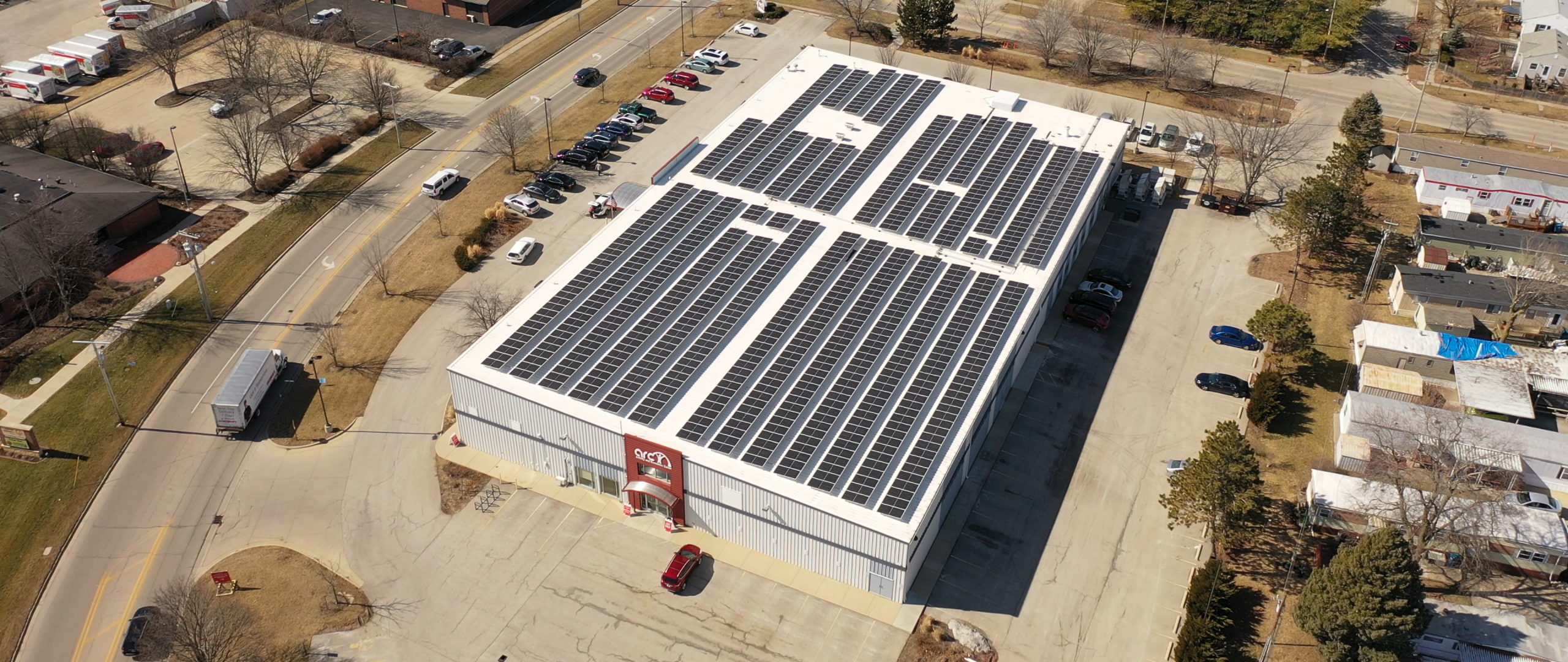
On-site solar for organizations
and public buildings.
Non-profit leaders and public administrators can lower electricity costs for their organizations by installing solar panels directly on their property through Illinois Solar for All. Approved Vendors are qualified solar companies that receive incentives to install these projects and follow requirements that ensure participating organizations save over time.
HOW YOU SAVE
- No or low upfront costs
- Ongoing fees will not exceed 50% of the value of the electricity generated by the solar project, ensuring savings.
HOW IT WORKS
1

Organizations review ILSFA’s criteria to gauge their eligibility.
2

The program provides a list of qualified and vetted solar companies called Approved Vendors, who will confirm eligibility for on-site solar.
3

Approved Vendors and organizations work together to plan and install solar panels on their property.
4

Approved Vendors use ILSFA incentives to provide payment terms that ensures organizations save money on their electric costs.
What Types of Organizations Can Participate in Illinois Solar for All: Non-Profit and Public Facilities?

To be eligible for Illinois Solar for All, organizations must meet the following criteria:
- Located in or adjacent to and serving residents of an ILSFA-designated environmental justice or income-eligible community.
- Operate as a non-profit or public entity that provides critical services and essential community services, such as hospitals, houses of worship, senior centers, food pantries, or libraries.
- Be a public facility that hosts a department or agency that is a critical service provider.
- Demonstrate community engagement.
Benefits of Bringing Solar to Your Organization
Savings
- No upfront costs
- Increase your control over your organization’s electric bills
Community Impact
- Reduce the impact of climate change
- Helps Illinois reach its renewable energy goals
Community Solar for Organizations
A single non-profit or public facility can also save money on electric bills by serving as a Community Solar “anchor subscriber.” Anchor subscribers have a larger share of the solar project, but no more than 40%. They may also host the community solar project on their property, but this is not required. Organizations interested in becoming Community Solar anchor subscribers must work with an Approved Vendor during project development. To learn more about Community Solar, visit our Community Solar sub-program page.
Frequently Asked Questions – Non-Profit and Public Facilities
With ILSFA, organizations will pay less on their electric bills than they would without the program. The graphic below is an example of how ILSFA can help lower an organization’s electricity bill.
If your solar installation includes monthly payments, they won’t exceed 50% of the value of the energy produced by the solar panels. In the example below, costs can be at most half ($600) of your yearly savings ($1,200), so you would not pay more than $600 in costs.
Monthly Energy Value
Average retail rate: 10 cents per kWh
Monthly production from solar project: 1,000 kWh
Energy value: 10 cents x 1,000 kWh = $100 in reduced electricity charges each month (from both avoided usage and bill credits)
Yearly Energy Value
Average retail rate: 10 cents per kWh
Monthly production from solar project: 12,000 kWh
Energy value: 10 cents x 12,000 kWh = $1,200 in reduced electricity costs
These savings assumptions are intended to provide a high-level example based on average retail electricity rates. Individual savings will vary. If your monthly credits are greater than your total electricity supply bill, those credits may roll over to the next month.
Your organization’s savings depend on the following factors:
- Average Electricity Rate: The higher the electricity rate your organization currently pays, the more money you can potentially save. You can check your utility bill to see your current rate.
- Your Site’s Suitability for Solar: The direction the roof faces, its angle, and how much shade it gets will affect how much electricity a roof-mounted solar project will generate. For ground-mounted systems, the area or land where the system would be installed must have no obstructions, flooding, or contamination.
- Optimizing Your System Size: Sharing your electricity usage history with an Approved Vendor will help them optimize your system. They will design a project that fits your building’s historical electricity use.
- How Long You Plan to Stay at Your Location: If you lease or sign a power purchase agreement, you may be required to buy out the contract if you move.
- Federal Tax Credits: Non-profit organizations and public facilities that own the system may be able to receive federal tax credits through a new mechanism called elective pay (also referred to as direct pay). For entities that choose a PPA or lease model, your Approved Vendor may be able to receive the tax credit as the owner of the energy property.
A qualified Critical Service Provider is a non-profit or public entity that offers critical services to income-eligible residents in or adjacent to income-eligible or environmental justice communities. View the list of Critical Services Providers to see if your type of organization is qualified.
Here are the most common options for financing your solar panels:
System Purchase: Your organization purchases the solar system, and uses the electricity generated by the system, with additional electricity sent to the electric grid in exchange for bill credits. its energy is credited to your electricity bill.
System Lease: Your organization leases the solar system, and the energy it produces creates credits on your electricity bill. The lease payments are capped at 50% of the value of the electricity generated.
Power Purchase Agreement: Your organization purchases the electricity generated by the solar project from the system owner. The project is on your organization’s property but is owned by someone else. Your costs under the PPA cannot exceed 50% of the value of the electricity generated.
Illinois Solar for All is a state solar program implemented by the Illinois Power Agency (IPA), an independent state agency of the State of Illinois. ILSFA protects organizations through clear requirements for Approved Vendors, transparent pricing, and straightforward contracts, ensuring participants know what to expect and who to turn to if something doesn’t seem right.
Approved Vendors must present a standard Disclosure Form before you sign a contract or any work can begin. Disclosure forms provide important information on exactly how much you will pay and estimates of how much you will save. You can even use the Disclosure Forms to compare offers from different Approved Vendors. The ILSFA program ensures savings and has a 14-day cancellation period without penalties.